
Contents
- Bronze Layer: Capturing Data Exactly as It Arrives
- Silver Layer: Transforming Raw Data into Trusted Information
- Gold Layer: Delivering Business Value
- Better Data Quality with Progressive Refinement
- Improved Scalability
- Strong Data Governance
- AI and Machine Learning Readiness
- Metadata-Driven Data Pipelines
- Lakehouse and ACID Transactions
- Bronze : Every transaction, clickstream event, and customer interaction is stored exactly as received.
- Silver : Now analysts have one trusted customer profile instead of multiple fragmented records.
- Gold : Executives see interactive dashboards instead of millions of raw rows, while data scientists consume curated features for demand forecasting and recommendation models.
- Final Thoughts
- Additional Resources
Why Modern Businesses Need More Than Just Data Storage
Data has become the backbone of every digital business. Organizations collect information from websites, mobile applications, IoT devices, ERP systems, CRMs, and cloud platforms every second. However, simply collecting data isn't enough. The real challenge lies in transforming raw, inconsistent information into trusted business insights.
This is where Medallion Architecture has emerged as one of the most effective design patterns in modern data engineering. Popularized within the Lakehouse ecosystem, the architecture organizes data into progressive quality layers—Bronze, Silver, and Gold—allowing organizations to improve data quality, governance, scalability, and analytical performance step by step. Rather than treating all data equally, it creates a structured journey from raw ingestion to business-ready intelligence. (Databricks Documentation)
Understanding the Bronze, Silver, and Gold Layers
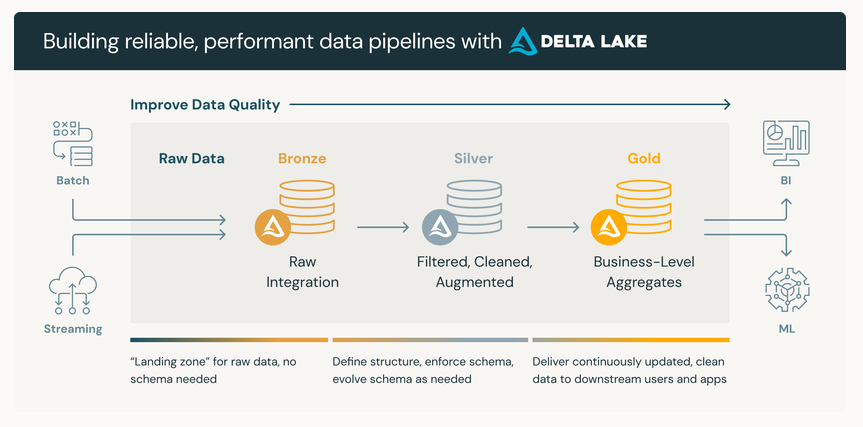
Source : Databricks Blog
Bronze Layer: Capturing Data Exactly as It Arrives
The Bronze layer is the landing zone for all incoming data. Here, data is stored in its original format with minimal or no transformation. The objective is not perfection but preservation.
Typical sources include:
Transaction databases
REST APIs
Kafka streams
CSV and Excel files
IoT sensor feeds
Social media data
Since every record is retained, organizations always have a reliable source of truth. If downstream transformations fail or business rules change, engineers can simply replay the pipeline from the Bronze layer instead of recollecting data from source systems. (Databricks Documentation)
Silver Layer: Transforming Raw Data into Trusted Information
The Silver layer is where engineering begins.
Here, data engineers perform:
Schema validation
Deduplication
Data quality checks
Standardization
Data enrichment
Data integration
Business rule implementation
This layer creates a clean, consistent, and reliable version of enterprise data. Silver datasets often become the "single source of truth" across the organization.
Gold Layer: Delivering Business Value
The Gold layer is designed for business consumption.
Instead of storing individual transactions, Gold contains aggregated and business-friendly datasets.
Examples include:
Monthly sales
Customer lifetime value
Marketing KPIs
Executive dashboards
Financial reporting
AI feature datasets
Business users rarely need millions of raw transactions. They need answers. This layer powers tools like Power BI, Tableau, Looker, and modern AI applications.
Why Medallion Architecture Has Become the Standard for Modern Data Engineering
Better Data Quality with Progressive Refinement
Instead of trying to clean data during ingestion, Medallion Architecture improves data quality incrementally.
Each layer has a specific responsibility:
Bronze preserves history.
Silver improves trust.
Gold delivers business value.
This separation makes pipelines easier to maintain while reducing production risks.
Improved Scalability
As organizations grow, data sources multiply rapidly.
Instead of rebuilding pipelines every time a new system is introduced, engineers simply ingest the new source into Bronze and extend the existing Silver and Gold transformations.
This modular approach significantly reduces engineering complexity.
Strong Data Governance
Modern enterprises must comply with regulations such as GDPR, HIPAA, and industry-specific governance standards.
Since every transformation is traceable from Gold back to Bronze, organizations gain:
Complete data lineage
Auditability
Reproducibility
Easier compliance reporting
AI and Machine Learning Readiness
AI models are only as good as the data they consume.
Gold datasets become ideal feature stores because they are:
Clean
Standardized
Consistent
Business validated
This dramatically improves prediction quality while reducing feature engineering effort.
Metadata-Driven Data Pipelines
Research and industry best practices increasingly emphasize treating metadata as a first-class citizen.
Modern Medallion implementations automatically capture:
Source system information
Ingestion timestamps
Pipeline versions
Schema evolution
Data quality scores
Transformation lineage
Metadata enables automated governance, debugging, impact analysis, and regulatory compliance while also improving trust in AI-generated insights.
Lakehouse and ACID Transactions
One of the biggest reasons Medallion Architecture has gained popularity is its close alignment with Lakehouse platforms. Technologies such as Delta Lake enable ACID transactions, schema enforcement, and time travel, allowing organizations to combine the flexibility of data lakes with the reliability of traditional warehouses. This means teams can rebuild downstream layers, recover from errors, and maintain consistent datasets without sacrificing scalability. (Databricks Documentation)
A Real-World Example: From Raw Sales Data to Executive Insights
Imagine a retail company receiving data from:
Shopify
Mobile applications
POS systems
Customer CRM
Marketing platforms
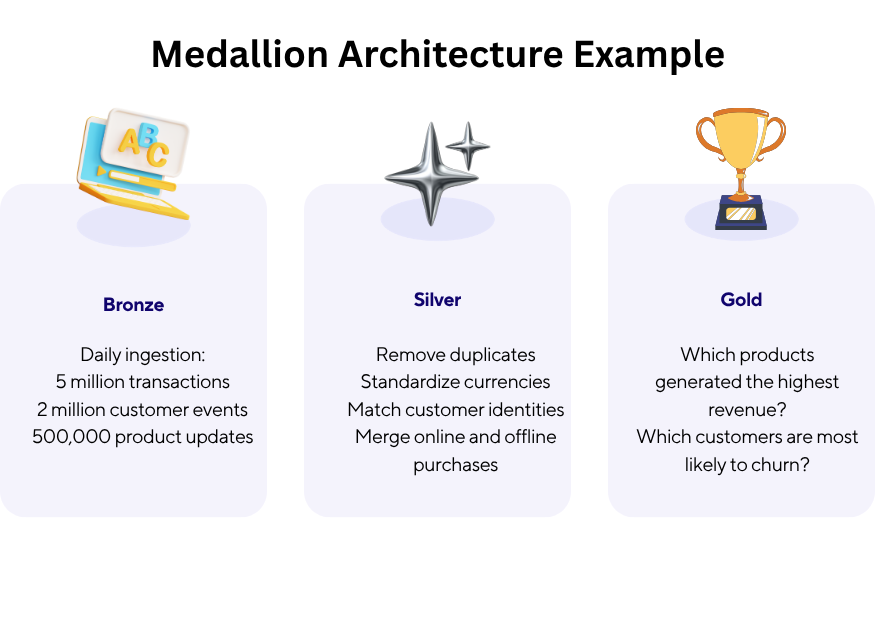
Bronze : Every transaction, clickstream event, and customer interaction is stored exactly as received.
Silver : Now analysts have one trusted customer profile instead of multiple fragmented records.
Gold : Executives see interactive dashboards instead of millions of raw rows, while data scientists consume curated features for demand forecasting and recommendation models.
Final Thoughts
Medallion Architecture has become much more than a popular design pattern—it is now a strategic framework for building reliable, scalable, and AI-ready data platforms. By progressively refining data from Bronze to Silver to Gold, organizations gain higher data quality, stronger governance, easier scalability, and faster business insights. Emerging research on advanced Silver-layer modeling and metadata-driven engineering further demonstrates that the future of data platforms lies in flexible, semantic, and reusable architectures.
For organizations looking to unlock the full value of their data, adopting Medallion Architecture is not simply a technical upgrade—it is an investment in long-term innovation. With the right strategy and implementation partner, such as FutureWebAI Consulting, businesses can build data platforms that power analytics today while preparing for tomorrow's AI-driven opportunities.
Additional Resources
1. Understanding MultiModal RAG Systems
2. Fundamentals of Vector Database
3. Prompt Engineering Techniques
4. Machine Learning for Supply Chain Domain